New Forms of Regional Security Amid Global Actors’ Competition
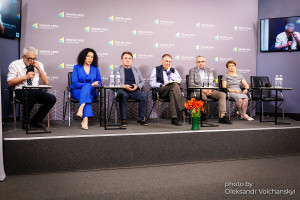
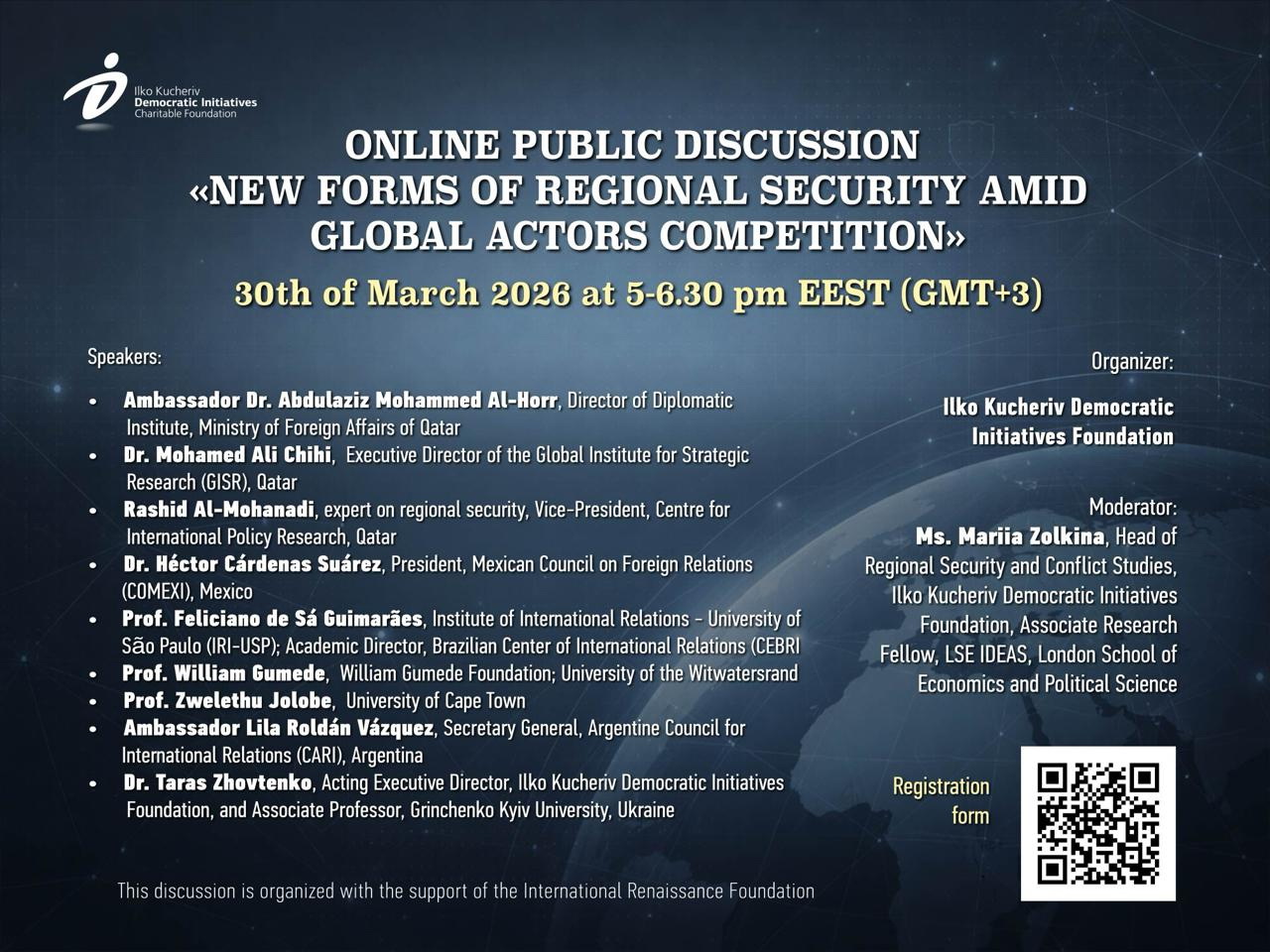 Online public discussion, 30th of March 2026, 5-6.30 pm EEST (GMT+3)
The event was dedicated to discussion and debate on how regional security idea, concept and design should be approached and shaped nowadays, in terms of the renewed Global Powers Competition from Latin America, Africa, Europe and the Gulf region perspectives.
The rising global US vs China rivalry and the repercussions and challenges connected to this competition are well felt and visible for basically all international actors around the globe, including those countries and continents represented in the discussion.
Middle East Views
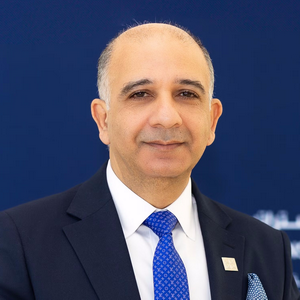 Dr. Mohamed Ali Chihi: One of the key consequences of the war on Iran is the transformation of the Middle East regional security from a U.S.-branded security model to a multi-polar security system based on pragmatic individual/bilateral security partnership approach and no unilateral dominance of any global or regional power.
The rise of autonomous middle powers who are no longer merely following the global superpowers, but are actively reshaping regional politics independently with pragmatic security and diversification, defines the key geopolitical shifts in regional security.
As the region faces a twin threat – the first is the Iranian threat from Iranian asymmetric networks, and the Israeli military expansion, regional powers seek stability through building diverse economic relations both with the US and China.
The new regional security model is based on specialized context-specific security aspects:
- trade and infrastructure;
- Board of Peace model;
- an institutional diplomatic flexibility;
- investment and humanitarian aid;
- non-ideological alliances and pragmatic partnership based on economic and security interests;
- diversification of partnership.
In terms of shift from interstate direct armed conflict to world intense proxy competition, the Middle East regional order is moving to a multipolar order based on independent regional powers and not on the dominance by any single power.
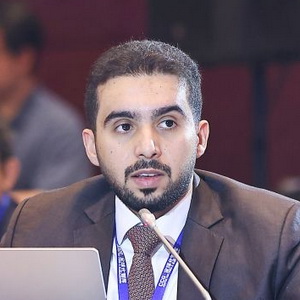 Rashid Al-Mohanadi: Gulf – Europe relations have been muted during the previous decades due to many regional and global events.
Presently two important dynamics emerge that are shifting the situation:
- The unpredictability of U.S. policy decisions, dictated by the United States perspective of its being locked into a great power competition with China.
- The aggressiveness of both US/Israeli attacks along with Iranian response.
These dynamics assist in protecting the converging European and Gulf interests.
Europe’s most favorable position is its defense approach towards Gulf states. This helps create the positive image of Europe among the Gulf states.
The biggest loser of the Iran war is China. Until now there is no meaningful actions from Beijing. Geopolitically the PRC is interested in tying the US down with a major regional war, on the other hand, the war inflicts economic pain on Beijin.
Latin American Views
 Dr. Hector Cardenas Suarez: Latin America is both important and vulnerable to regional/US security.
Strategic shift of the US foreign policy makes the region central to the US interests and security.
There are three immediate implications to this change:
- An increased pressure on countries in the region in different areas, influenced by the US–China global competition.
- A much more transactional and selective approach to the US policies.
- The disruptive and non-traditional actions by the US.
Mexico–US is an example of asymmetric interdependence. Mexico cautiously accommodated US demands, however in the long term this interdependence will create a kind of resilience from the Mexican side, limiting what the US could actually do to Mexico.
Cuba might be a similar case to the US as Iran, as Cuban regime is deeply entrenched. Mexico may try to become the mediator between Cuba and the US.
US–China rivalry is fundamental for Mexico and other US partners in the region. US simply cannot compete with China without regional partners.
Security alignment with the US vs economic cooperation with China is a challenging question for Mexico and Latin America region.
The region will play crucial role in this US–China rivalry, however the it is not prepared to take advantage of its position through increased regional cooperation.
Regional security is shaped in Washington and Beijing – not only by the regions themselves.
Latin America is going to have a growing strategic relevance in global competition because of this competition between China and the United States.
However, the region does not seem to be prepared for this challenge – Latin America right now lacks a coherent strategy, both internal and external, caused by the following factors:
- low growth pattern of development;
- institutional weakness;
- substantial political fragmentation amongst left / right wing parties in the countries of the region.
 Ambassador Lila Roldan Vazquez: Multilateralism is being overruled by unilateral states actions and their disregard for international law, particularly the UN Security Council is not fulfilling its main objective, which is promoting peace and security and looking for states to stop fighting to each other.
Thus, the confrontation between great powers inevitably leads to these situations. And the international arena is convulsed as countries sometimes don't seem to not know what to do in the face of this challenge.
They either align themselves with one of the conflicting powers, or they prioritize their own security interests, economic interests, and try to accommodate their politics to navigate this extremely complex world.
Latin America is not an exception, being affected by the US–China competition.
The US was economically, financially (but not politically) absent from the Latin America region for a long time, which left the void filled by China.
It is now the second commercial partner after the United States in the region, and the first importer of some countries in the region like Brazil, Peru or Chile.
Russia, on the other hand, lacking the economic power to have a substantial presence in the region, has been trying to move public opinion towards either neutrality in the conflicts, for instance, with its war on Ukraine, or against the United States policies.
Among the benefits of our region, there are not only geography and natural resources, but also the fact that Latin America is a region of peace – since 1967 it is non-nuclear and free of conflicts region with mainly democratic nations.
According to November 2025 US National Security Strategy, Washington positions itself as the partner of choice for the Latin America countries with "enlisting" all US partners to US priorities, and "enlarging" by looking for the new partners in the region.
Latin American nations identify themselves more with EU than with the US – and the EU is also changing its approach toward the region to enhance cooperation.
The region has to leave aside all this political conundrum and join in a real regional cooperation association to be able to face all these challenges that the world is putting in front of us.
 Professor Feliciano de Sa Guimaraes: Latin America is polarized and it is difficult to tighten regional cooperation.
Diversification is a key Brazilian strategy and foreign policy for decades.
For Brazil, the new US National Security Strategy is a direct threat meaning Brazil could be the next target after Venezuela.
The return of the spheres of interests is a point for possible future cooperation between Brazil and Ukraine, as Ukraine is also a victim of that concept.
Brazil is one of the biggest Latin American partners of China, with a trade surplus with China of $80 billion and China being Brazil's number one trade partner.
The US is trying its best to change that by trying to influence elections and turn Brazil economically from China (which is extremely hard to do).
The US is trying to isolate and to alienate Brazil from other nations of the region. In this scenario of isolation, BRICS is an alternative, as well as relations with Europe. The EU, Turkey, India could be alternatives to the US in terms of military equipment supply.
While the US is losing the economic influence on Brazil, Brazil could well become a subject of US using other, military instruments against it.
African Views
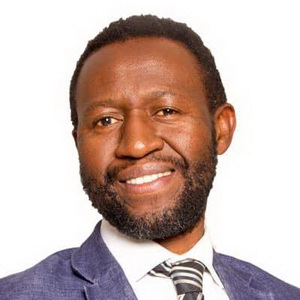 Professor William Gumede: From the African point of view, Trump Administration found African nations in a weakened position influenced by COVID and Russian – Ukraine war and the war in Iran.
The African Union as a continental entity finds itself in a crisis. The AU is also weakened by internal divisions and regional conflicts enabled by outer actors.
The challenge for South Africa is that the US is going to target South Africa political leaders in terms of SA domestic politics, trying to influence domestic political landscape in SA to bring the pro-Trump government to power in 2029.
Economic ties between US and South Africa remain strong, making the US one of the biggest trade partners of SA. The US will remain a big player in SA economy and humanitarian cooperation (NGOs etc.).
African nations have failed to forge regional cooperation on rare earth minerals as US (along with China) expressed great interest in getting access to it.
Ukrainian Views
 Dr. Taras Zhovtenko: The parallels, which are very clear to see between different regions, the Gulf, Latin America, and Europe, are defined by the same challenges in terms of how the US is trying to reshape its own strategic approaches to its foreign and security policy.
All the regions are affected by this attempt of the Trump administration to reshape its political strategy. To some extent, the ramifications of this reshaping reverberate in all regions more or less the same, because the United States has been trying to play the dominant role on a global level for four decades, and the US has been building its own international partnerships and international coalitions to support its own global role in different regions.
Current US Administration is trying to implement the strategic shift from traditional foreign and security policy to transactional one.
Europe has, for decades, been the security partner of the United States and the recipient of the US security resources and US security efforts.
The European leaders right now are trying to find the way out of the situation of this huge strategic dependence from the United States of America, first of all, in terms of technology and military equipment, as well as strategic security instruments. These efforts are currently enhanced and multiplied by the joint US and Israel military actions against Iran.
There are two key aspects of these efforts of perceiving of the strategic autonomy from the United States in terms of the strategic security – conventional and nuclear ones.
European military industrial companies are capable of shifting gears and trying to at least scale up double or triple of their production of the conventional weapons. In these terms, they could possibly catch up with what American military companies, military industrial complex is doing right now.
But what the European right now lacks, and it tries to pay more and more attention to this, is the instrument of maintaining its own strategic security, first of all, the nuclear deterrence of the Russian Federation.
This is something which the European nations have never looked at but they are forced to do so because of the actions of the Trump administration, not only in Europe, and also in terms of the war in Iran.
One of the most obvious strategic outcomes of the latter war would probably be the situation when the non-nuclear states would be trying to rethink its non-nuclear status and would perceive the acquisition of their own national nuclear arsenals as one of the key instruments for maintaining their own national security.
That would dramatically shift balance in all regions, not only in the Gulf region.
It could be some potentially dangerous trend, which would lead to further escalations of regional conflict.
Those regional conflicts could then be combined into what could be called the global hybrid war or global hybrid conflict which would involve regional wars in the key regions of the planet with the key players (such as the United States or Europe) unable to deal with the outcomes and unable to stop those conflicts, and that would be eventually the end of the unipolar system and what comes next is going to be another big question.
Russia is feeding on Iranian war experience to be ready to implement its key approaches in and against Europe, while providing Tehran with the wartime experience of its own.
Europe is seeing that the US turns to be a very non-reliable ally in terms of regional and strategic security. In this circumstances, European nations try to maintain both their own strategic approach to conventional security and their approach to the future partnership with the Trump Administration and with the Trump's United States.
This shapes up the common security threats environment not only for Europe and Gulf, but also potentially for other regions involved in the global hybrid confrontation.