Addressing Militarisation, Recruitment, Abduction, and Indoctrination of Children: Africa’s Lessons for Ukraine
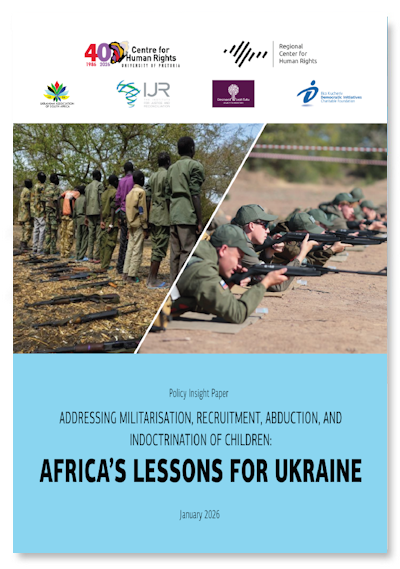 The recruitment, indoctrination, and exploitation of children in armed conflicts is a persistent and deeply troubling challenge that has affected the African continent for decades. The recruitment and use of children in armed conflicts remains a grave violation of international law and a profound challenge across the African continent and abroad.
Despite international and regional legal frameworks, the use of children as soldiers, porters, spies, and tools of war continues to spread across the continent. The scale of the problem has only increased over time, becoming more systematic and complex, as illustrated by the case of Ukrainian children forcibly deported, militarised, and indoctrinated by the Russian Federation. This demonstrates that child exploitation in armed conflicts is not only an African challenge but a global one, and that Africa’s experience provides critical lessons for international responses.
This policy brief examines the impact of conflicts on children in Uganda, the Democratic Republic of the Congo, Sudan, Sierra Leone, Liberia, and Ukraine. These conflicts highlight patterns of abduction, forced recruitment, sexual exploitation, cultural erasure, and systematic militarisation. The long-term consequences include profound physical and psychological trauma, disrupted education, fractured communities, and diminished future opportunities. In Ukraine, the Russian occupation has escalated these practices on a large scale, with forced displacement, cultural assimilation, militarised re-education, and the erasure of national identity, showing how these violations can become more systematic and far-reaching. This mirrors, and in some cases expands upon, methods long documented in African conflicts, underscoring the global nature of the threat and the urgency of shared solutions.
Building on Africa’s extensive experience in addressing child recruitment, abduction, and post-conflict reintegration, this brief advocates for a unified, multidimensional approach. It emphasises the need to strengthen child protection frameworks, enhance accountability through international legal mechanisms, and expand cooperation between African and Ukrainian governments, civil society, and international institutions. Special attention is given to the importance of Disarmament, Demobilisation, and Reintegration (DDR) programs, safe repatriation mechanisms, trauma-informed rehabilitation, and the restoration of children’s identities and rights.
Supporting legal frameworks and international mechanisms to prevent child Africa’s decades of engagement with these challenges provide critical lessons, practical tools, and moral authority that can guide global efforts to protect children affected by armed conflict, including Ukrainian children currently under Russian control. By acting decisively and collaboratively, African Union member states, international partners, and civil society can help ensure justice, rehabilitation, and sustainable peace, affirming a shared commitment to safeguarding every child as a bearer of rights and a future contributor to society.
Over the last three years, the number of conflicts and grave violations against children in armed conflict has alarmingly increased. Despite over 30 years of international and continental efforts to address it, the recruitment, abduction, indoctrination and exploitation of children in armed conflict remain among the most persistent and grave violations of international law. These issues continue to have a profound impact on societies throughout the African continent and increasingly, beyond.
The number of affected children has risen sharply in recent years. In 2024, the African Committee of Experts on the Rights and Welfare of the Child (ACERWC) estimated that up to 183 million children across the African continent were living in conflict zones. In the same year, the United Nations verified 41,370 grave violations against children in armed conflict: the highest number since record-keeping began. West and Central Africa have been identified by the UN as regions with the highest verified numbers of child recruitment.
Despite international condemnation and legal prohibitions in several international treaties, militarisation of children and child recruitment persist. Key legal instruments establish 18 as the minimum age for compulsory recruitment/direct participation, while others set it at 15,8 creating inconsistencies. Enforcement relies heavily on state implementation and international/ regional pressure. The Economic Community of West African States (ECOWAS) developed a Child Policy that serves as the overarching framework for promoting and protecting the rights of children across the 15 member states and specifically addresses the issue of child soldiers as part of its broader commitment to child protection in contexts of armed conflict. However, all these mechanisms face serious political and implementation challenges.